DISCLOSURE
4-13 September 2026 – Pie Factory, Margate
Bev Howard & David Nettleingham
GUEST ARTISTS
INSTALLATION 1:
Maxine Chester – SHIFT… (2026)
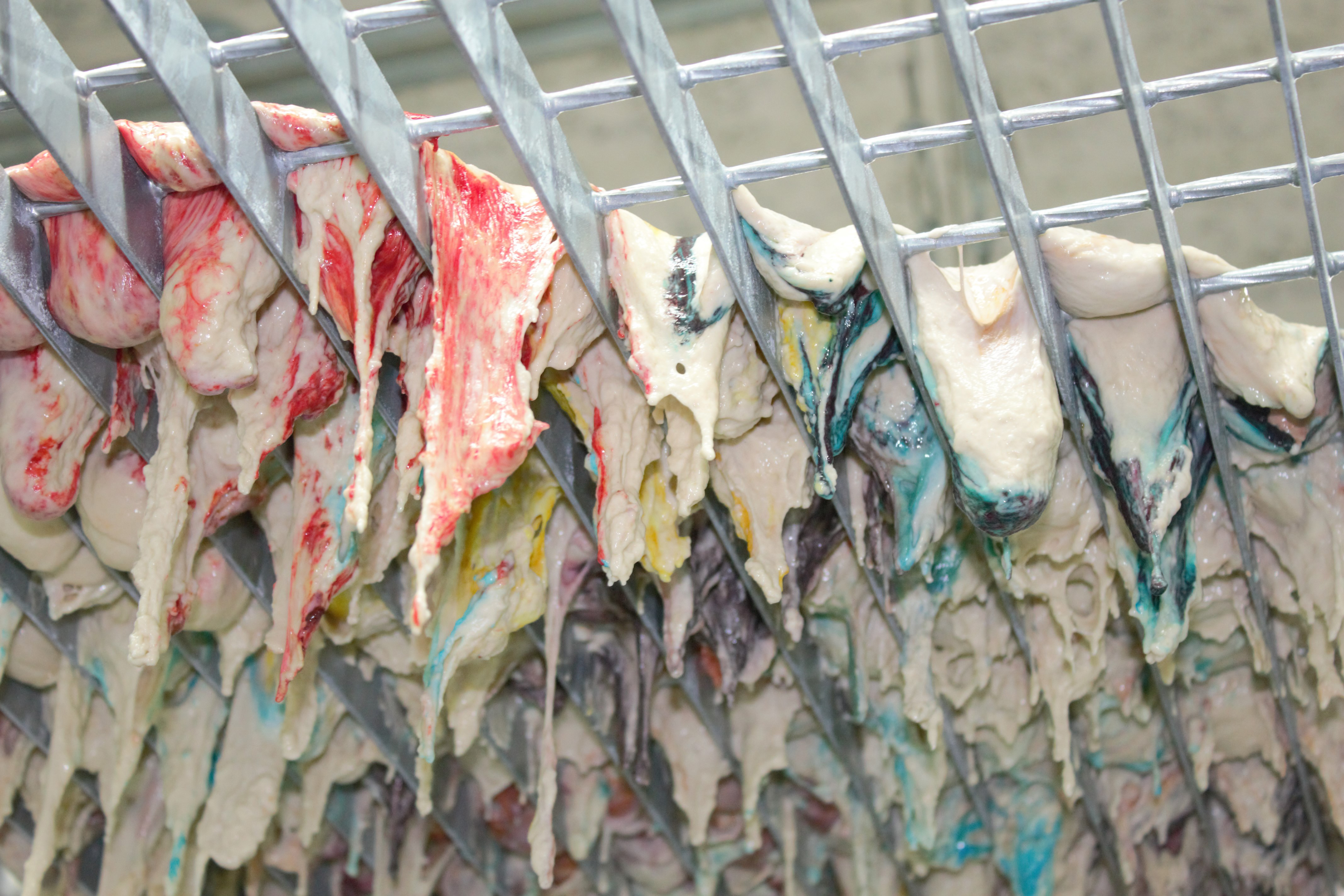
100cm x 100cm x 210cm
SHIFT… is a live, multi-sensory sculpture incorporating raw yeast bread dough. Maxine Chester explores ideas relating to life cycles – decay and rejuvenation; ageing and states of becoming. Materials are viewed as vibrant and have a type of agency. Chester sees herself as a catalyst where she activates the live raw yeast bread dough to enhance energetic states. Fermentation, a metabolic process, occurs where single-celled fungi convert sugar into energy. Over time, the raw yeast bread dough changes – decay and rejuvenation take place. A multi-celled fungus develops, and the life cycle continues. Rather than viewing the bread dough as passive it is seen as vibrant and active possessing its own trajectory. Viewers are invited to consider their own states of change through the activity of the materials.
Many thanks to all the bread dough makers, and to ADH Scaffolding.
Please feel free to touch the bread dough.
INSTALLATION 2:
Various Artists – THIS (WASTE) LAND IS OUR LAND (2026)
Katie Blythe – Sigil of the Elder Millennial (2026)
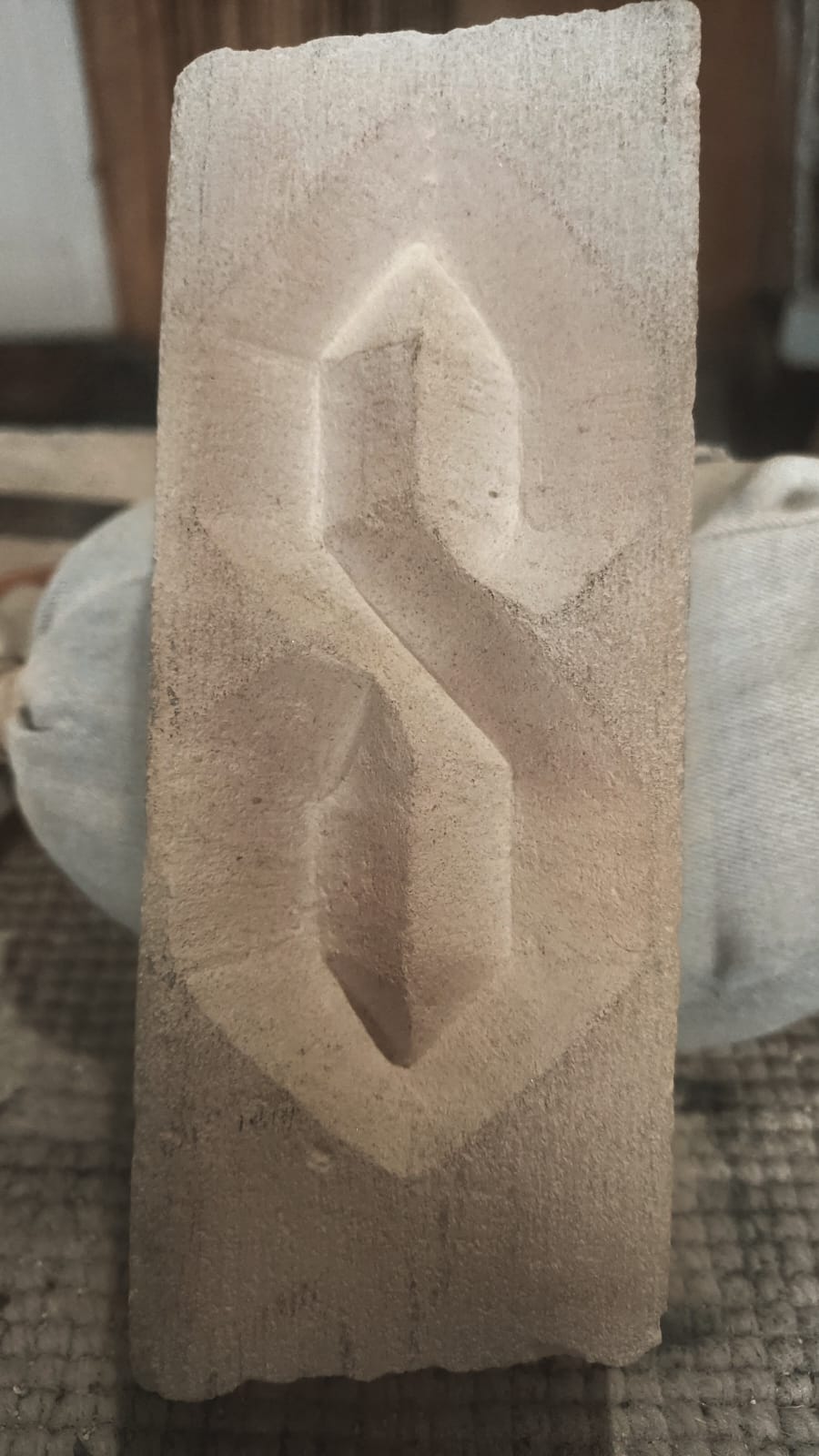
Lavoux stone
£420
The Sigil of the Elder Millennial takes the ubiquitous “Cool S”, relentlessly scribed into school exercise books, pencil cases, desks, and margins, and translates it into Cathedral stone.
For a pre-internet generation, the symbol seemed to exist everywhere and nowhere: an offline meme before we had the language to describe it as such. Passed from child to child like a talisman, its origins remain obscure, its meaning uncertain, and yet somehow everybody knew how to draw it. It functioned almost like a piece of playground folklore: learned through imitation, repeated compulsively, and transmitted without explanation.
Carving the Cool S into limestone gives this ephemeral mark the permanence and authority of an ancient inscription. Presented as a “sigil”, it becomes an archaeological artefact imbued with an imagined magical significance: a mysterious mark left behind by a generation now old enough to find the material culture of its childhood becoming history.
@katierblythe
Esme Bone – The Time For Decay (2026)
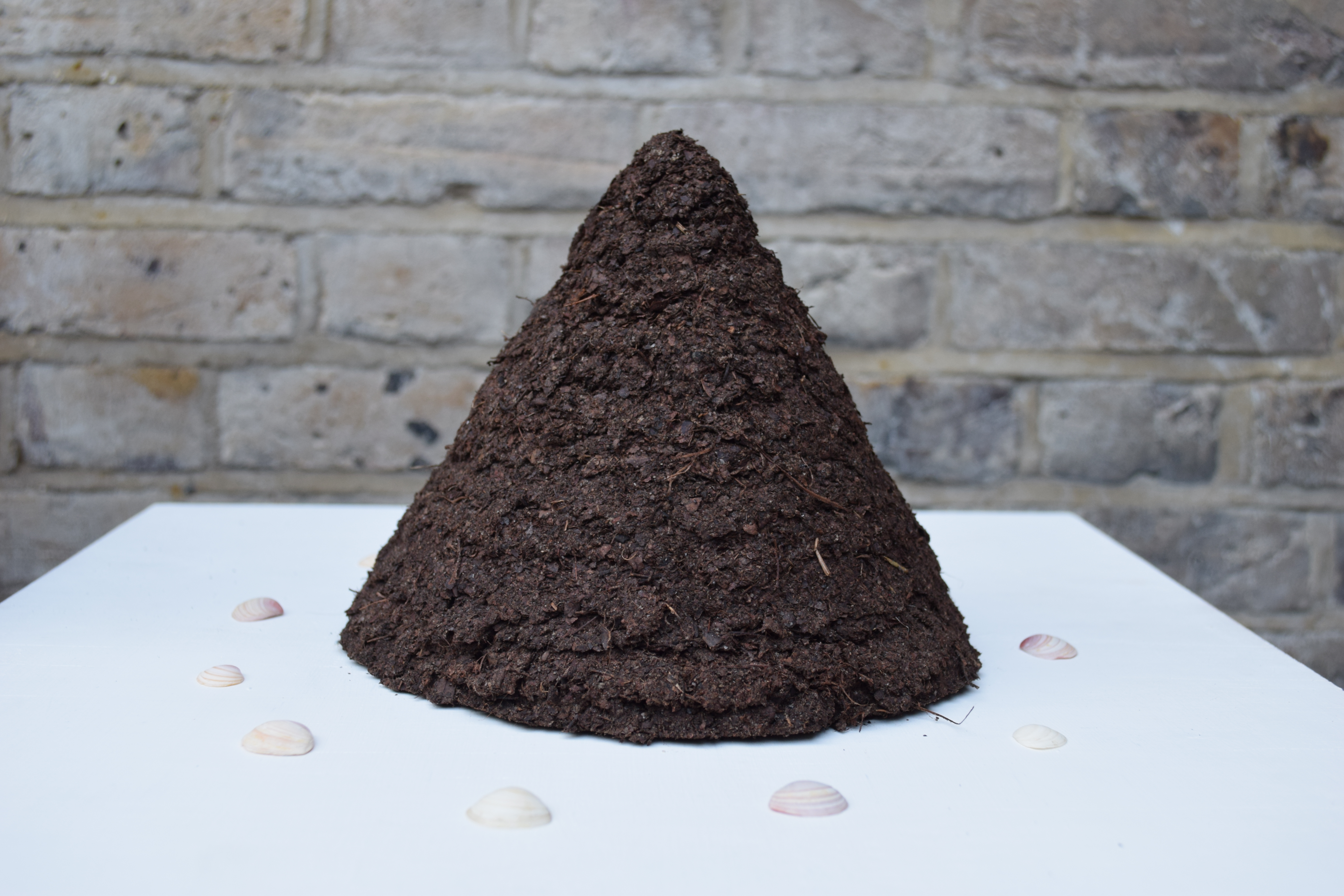
Leaves, shells and wooden base (17cm x 40cm x 40cm)
NFS
Esme Bone joins small blobs of material together using repetitive, process-led methods to build structures that respond to the lively, changing world around her. She uses a mixture of materials closely sourced from her environment in processes that engage with regeneration, repair, and circularity. ‘The Time For Decay’ is a sculpture made from collected fallen leaves, pulped down and coiled round one layer at a time to form a mountain. Shells have been placed around the base of the mountain as an ode to the sandcastle, the joyous and ephemeral structure we instinctively build on the shore, awaiting the tide.
@esmebone
Sara Cadogan – Take Me There (2026)
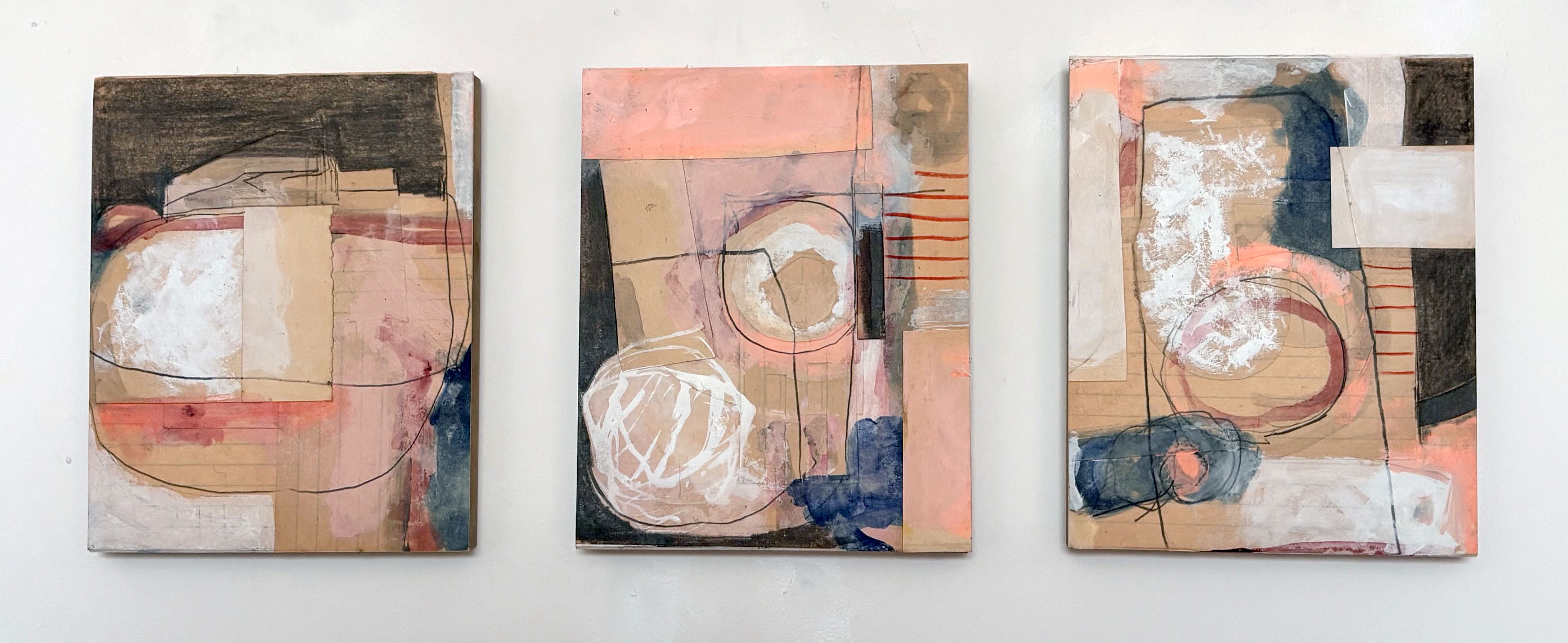
Triptych – vintage papers, ink, acrylic, graphite and crayon on card and mounted on MDF (18.5cm x 15cm)
£400
This work, Take Me There, inhabits the uncertain terrain between presence and absence, where the image is held not as a fixed record but as something fragile, shifting, and incomplete. For Sara Cadogan, place and memory are never whole. They are broken by time, blurred by distance, and altered by the small acts of forgetting that sit alongside remembering. Memory is shaped by barriers as much as by revelation: what is concealed, interrupted, or enclosed often carries as much weight as what is visible. These thresholds become the site of the work, where ink bleeds into paper fibres, narratives fracture, and only scraps, smudges, and faint impressions remain.
The work moves into a more abstract, elemental visual language, where old papers, graphite, crayon, diluted paint, and ink act as carriers of sensation rather than description. Here, material becomes a kind of witness—absorbing touch, pressure, and time—holding what cannot be fully retrieved. The paper itself becomes an enclosure: a surface that both contains and resists, preserving traces while withholding complete access. These drawings are not depictions of place, but territories of recollection—spaces where paper, pigment, and residue remain suspended, allowing memory to emerge through sites of containment, as trace, atmosphere, and quiet accumulation rather than image.
In its materiality, Sara Cadogan’s work draws on a domestic vernacular through the collection and reworking of found paper, card, fabric, and old photographs. These materials are not treated as archival evidence but as carriers of residual memory, open to disruption and reconfiguration. Through collage, drawing, and paint, she dismantles and reassembles them to test how meaning shifts when familiar objects are removed from their original context. The work is driven by the idea that memory is not stable but fragmentary and constructed. Marks, surfaces, and photographic remnants are reduced to traces rather than representations, operating as partial signals of something once known. These elements hover between recognition and abstraction, where an image or object is felt rather than fully read, and where meaning is continually deferred through transformation. Rather than preserving the past, Cadogan’s work exposes how it is continually rewritten through material encounter. Layering, erasure, and repetition become methods for destabilising fixed histories, allowing objects to lose their original certainty and take on new relational meanings. In this way, the work proposes memory as an active process of making and unmaking, where fragments are never resolved but remain in flux. Positioned in the present, the work uses these reconfigured traces to generate new narratives. It becomes a space in which objects and marks are continually reassembled, suggesting that what is remembered is always provisional—shaped as much by the act of making as by what is recalled.
@saracadoganartworks
Russell Chater – Untitled (Wasteland) (2026)
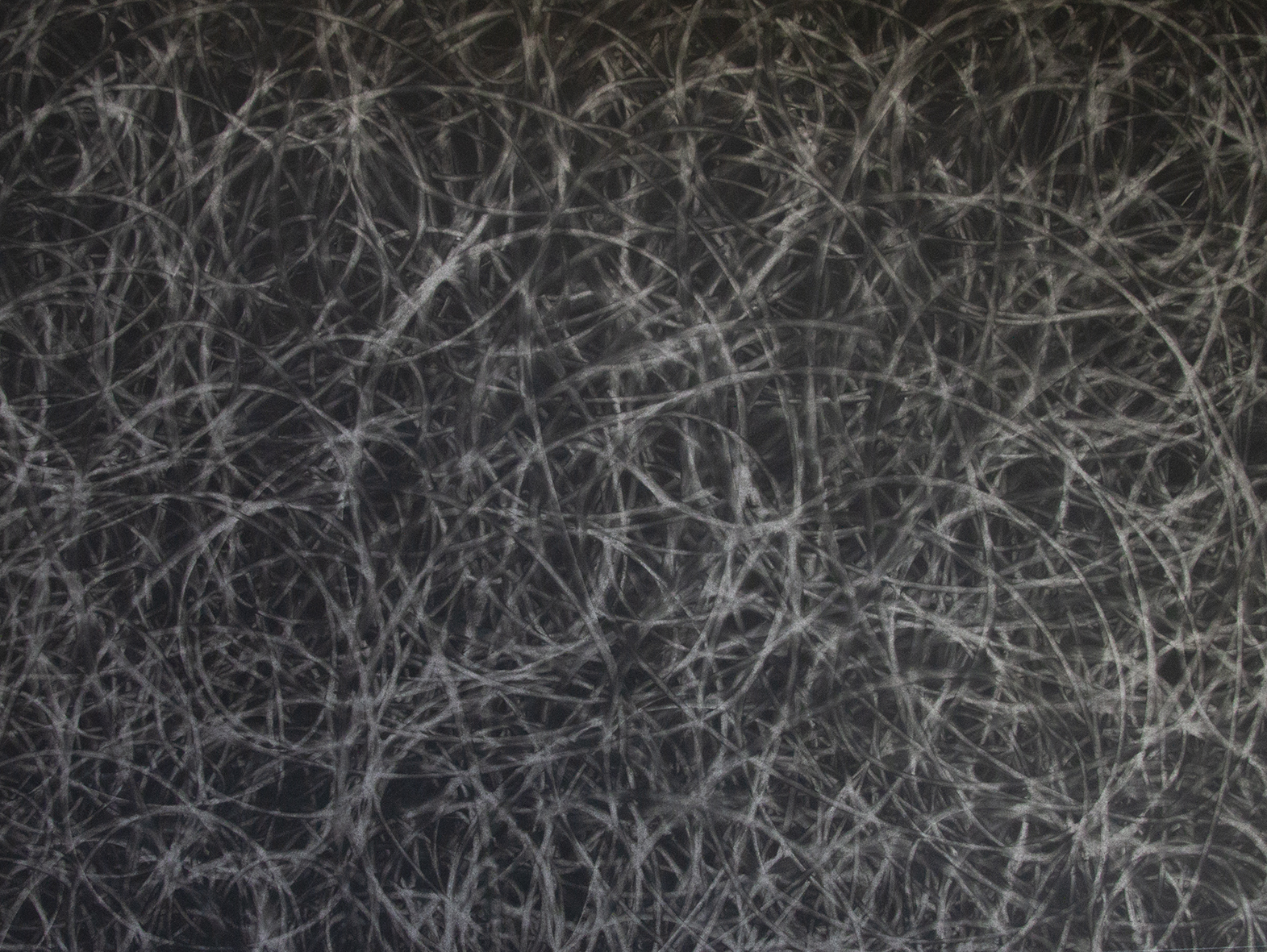
Compressed charcoal on 200gsm Fabriano Accademia paper (91.5cm x 122cm)
POA
Russell Chater is a Ramsgate-based artist and graduate of the MA Fine Art course at Central Saint Martins. A qualified lecturer with teaching including University of the Arts London and The Royal Academy, Russell has given talks on his practice in a range of Institutions. Russell has co-curated exhibitions, undertaken residencies and organised and chaired artist discussion sessions. The artist exhibits in the UK and overseas and his works are held in a number of private collections. Russell is also currently arts writer for the Ramsgate Recorder magazine.
Russell works across a variety of media, including drawing. The artists erased drawings originated as an offshoot from his use of swirling whitewash (a recurring motif). The obfuscation of the wash here becomes erasure: the swirls of an eraser create a web; a space; a state – simultaneously drawing you in and keeping you out. Infinite loops disclosing everything and nothing.
@russellchater
Katie Cohen – Leave Wings (2024)
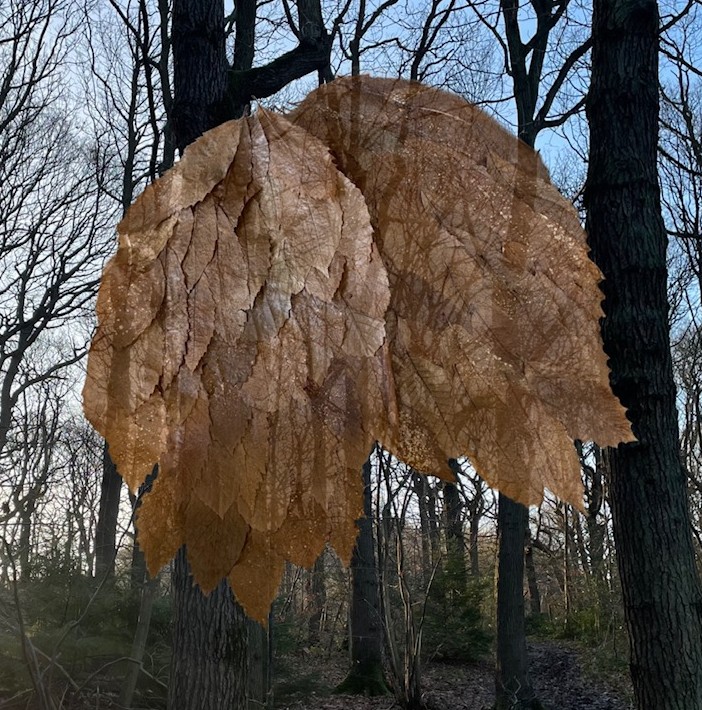
Beech leaves and Wonderweb (80cm x 40cm each)
£300
Katie Cohen’s practice combines printmaking, photography and sculpture. She often works with found materials, including leaves, wood, clay and other waste products, using her hands to alter their physical qualities or to create a transference, where the image or essence of an object is transformed.
Cohen is interested in animism and in whether a return to a more animated way of living could help us respond to the challenges currently faced by earth dwellers. Her work develops through processes of iteration, experimentation and responding to the possibilities of different materials and mediums.
The Leave Wings were originally created in 2024 for a work in which Cohen became a female embodiment of Kairos. In Disclosure, the wings have been shed possibly surplus to requirement. Made from collected beech leaves and Wonderweb, they remain as traces of this earlier embodiment, taking on a different meaning within this work.
@ms.ktco
Emiliano Darquea – Olding (2026)
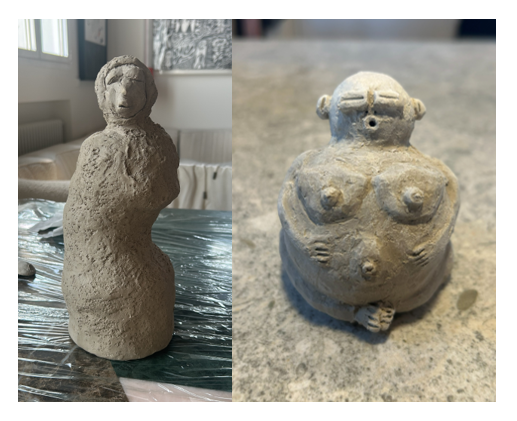
Ceramic (Left: 14.5cm x 14.5cm x 29.4cm & Right: 6.2cm x 6.2cm x 10.5cm)
NFS
Emiliano Darquea is a Canterbury based artist currently studying Fine Art BA at UCA. Born in Florida, He arrived in England seeking opportunity and a broader perspective on the art scene that is less present in his home country. He is early in his art career and hopes to outreach and expand to a larger audience. He has previously displayed work in Crate as a part of Muddy Me.
Primarily working in ceramics, he draws inspiration from ancient clay figurines of people and gods. He attempts to encapsulate the exaggerated curves, edges, and abstract shapes often found in early depictions of humanity while also implementing his own day-to-day experiences.
The larger piece was inspired by a derelict stone fountain by the side of a road. The water had evaporated, leaving a husk. The small piece was made in reference to the Ecuadorian Chorrera Ceramic figures and bowls.
@emiliano_darquea
Bev Howard – Suspended (2024)
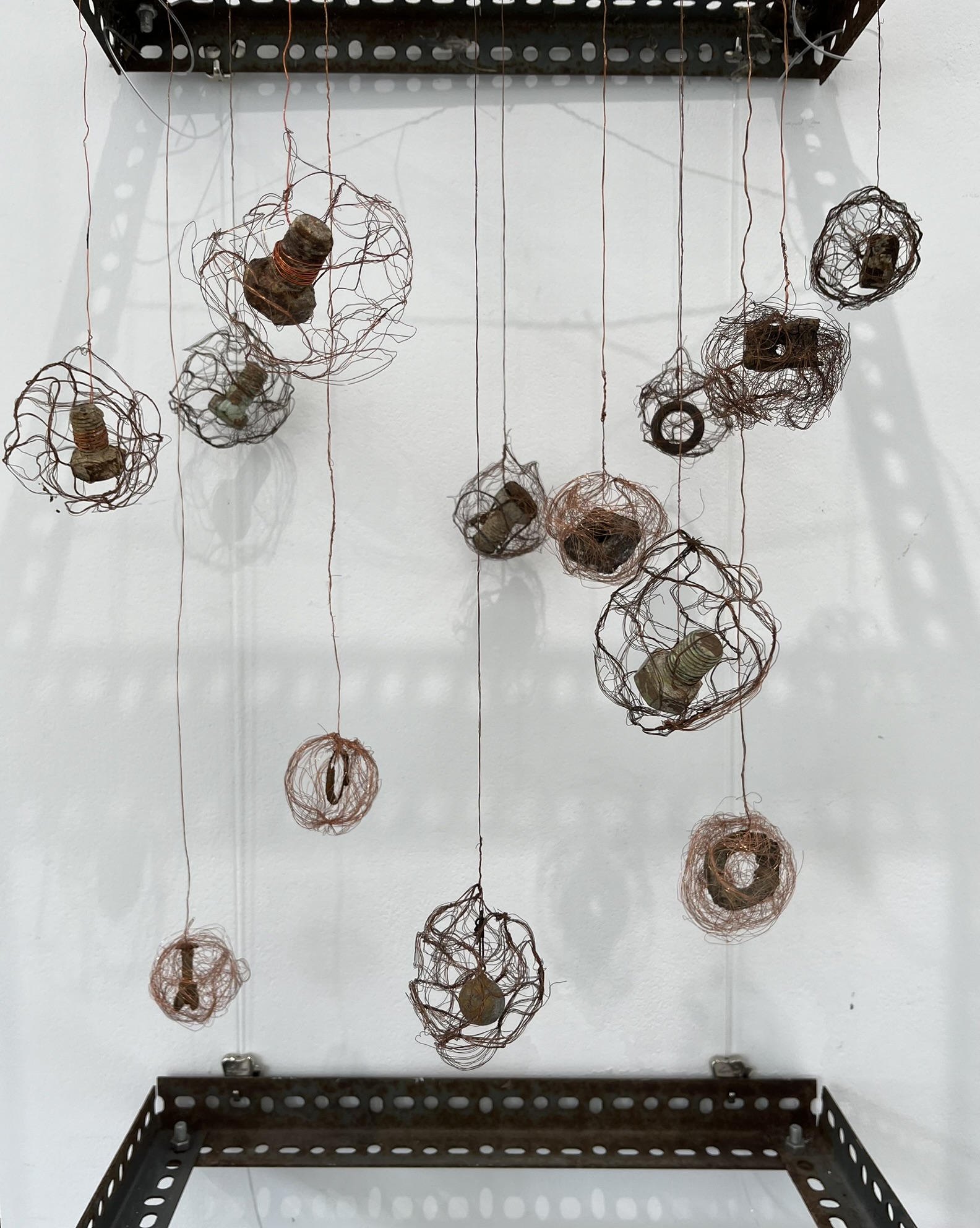
Made entirely from discarded material
NFS
Suspension is form of support as well as a form of uncertainty. Subject to forces outside of ourselves, there is also the possibility of movement not given by groundedness.
@bevfh
EJ Laven – Wisdom (1995/96)
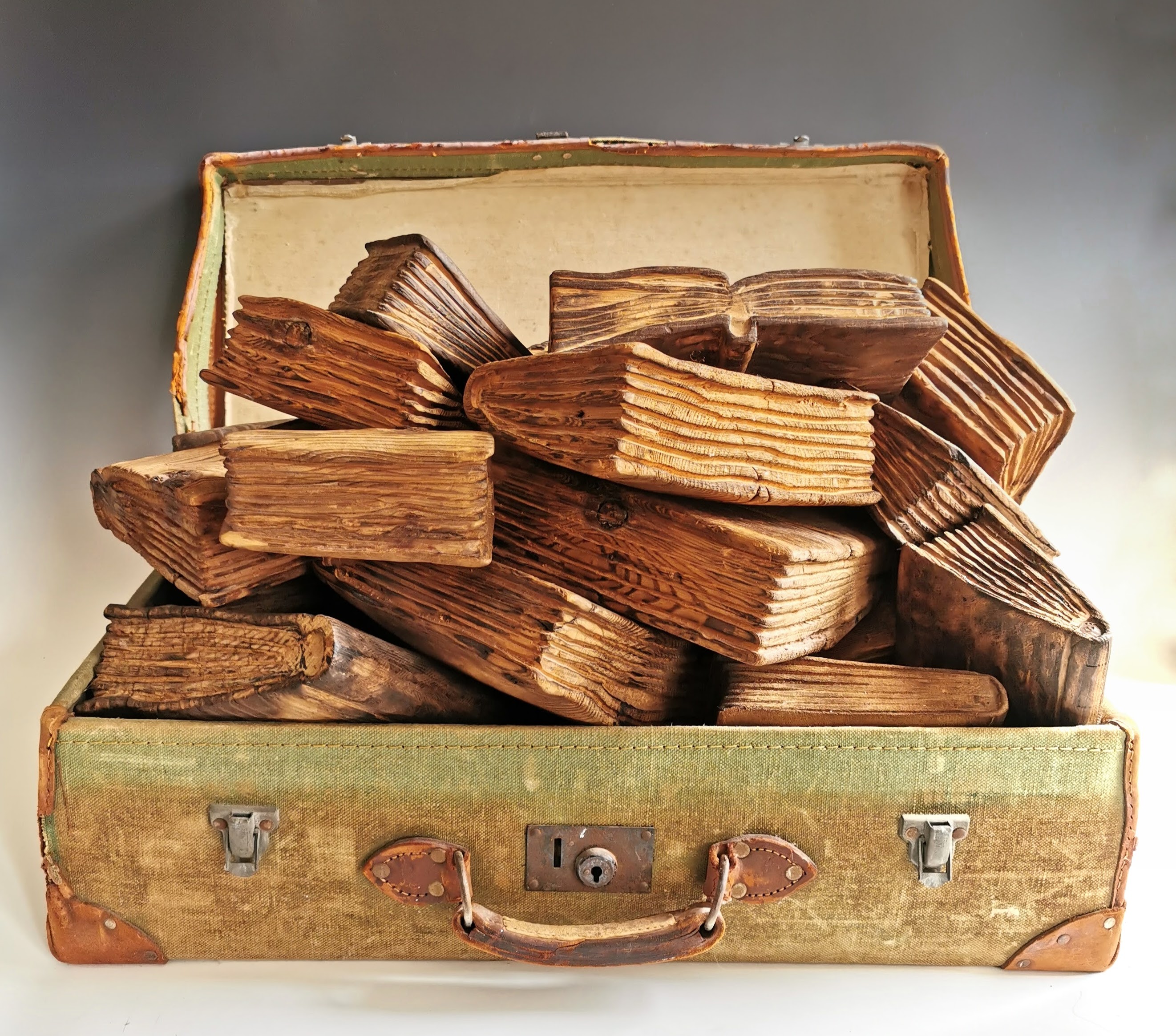
Reclaimed wood (including railway sleepers) and suitcase (65cm x 60cm x 50cm)
NFS
As a student in the 90’s, I lived on the Sussex coast, in a house made from old railway carriages. The summers were great; the winter’s chilly and damp, but it was very cheap, hugely romantic and I loved it. The carriages had been left there following WWI to provide temporary emergency housing. A quick lick of paint and some wallpaper here and there had been applied to make them more home-like but evidence of their former function remained everywhere – embossed plaques to request the public to refrain from spitting to prevent the spread of consumption; ashtrays, droplight windows; emergency cords etc. and it was impossible to resist it infusing my imagination- the numerous journeys they had once made; the people, the noises, the smells, the luggage and the stories that had unfolded on the tracks – a first holiday to the seaside, a chance encounter with another passenger, the books read, the anticipation of arriving somewhere new with just a suitcase of possessions, the marvels of the technology of the day and of course the horrors and senseless atrocities of war.
It was around this time that I created ‘Wisdom’, well at least started it. The piece went on to evolve and develop its own story. The books themselves were carved from a variety of woods but most originate from old railway sleepers. Burning and wire brushing brought out their irregularities, character and grain and gave them the feel of things that have passed through numerous hands and gathered a patina through time. Their static wooden pages render their contents forever unknown. Originally intended to be exhibited as a single stack of books, I had bundled them into an old suitcase (that I had been using for another piece which explored memory and loss) as a way of carrying them to a gallery where they were briefly left on the floor whilst I went to park my car. When I returned, I was surprised to see that that the gallery assistant had added a label to the suitcase of books and given it a name –‘Wisdom’. They explained that (unbeknown to me), the suitcase had the name ‘C.W. Wisdom’ written on it and they’d therefore assumed, because of the books, it had to be the title. A happy accident maybe, …but it worked and the juxtaposition of the pile of charred books in the battered and worn suitcase created a more emotionally loaded and meaningful piece than the original design would have ever been.
The Cambridge dictionary describes Wisdom as ‘the ability to use your knowledge and experience to make good decisions and judgements. Given that we have reached a critical point in the development of AI, we should perhaps reflect on the meaning of Wisdom. Our new technologies offer us immense potential, yet there is caution to be observed too. How will all this knowledge, amassed by humankind over millennia be used, shared or distorted; how will it build new ideas; what will become of books and the written word and, above all how will it affect our relationships with one another and indeed, the truth? AI already holds vast amounts of information and knowledge, but can it ever actually be sufficiently wise to help us to work together to deal with the imminent challenges that we and our planet face, without having had a life lived, experience of real and deep emotion and of the human condition itself?
Oh, and by the way…… the lettering on the suitcase. It isn’t the name of a person called Wisdom after all. A recent, closer look revealed that it actually says C.W.W15DOM and the meaning of this really is a mystery or perhaps another story to be disclosed.
E.J.Laven’s ceramics, painting, sculpture and installations often explore the point where land meets sea and the objects washed up or discarded along the shoreline. Collections, museum displays and strange or unfathomable artefacts often influence the manner in which her work develops or is presented. Over the years she has undertaken a number of public sculpture commissions; had frequent exhibitions; run a small ceramics business; delivered community arts projects; been an artist-in-residence; made props for a children’s TV show and spent several years teaching Art and Design in schools as well as Pottery and Ceramics to the wider community.
@ejlaven
Patrick Lears – Scorch (2026)
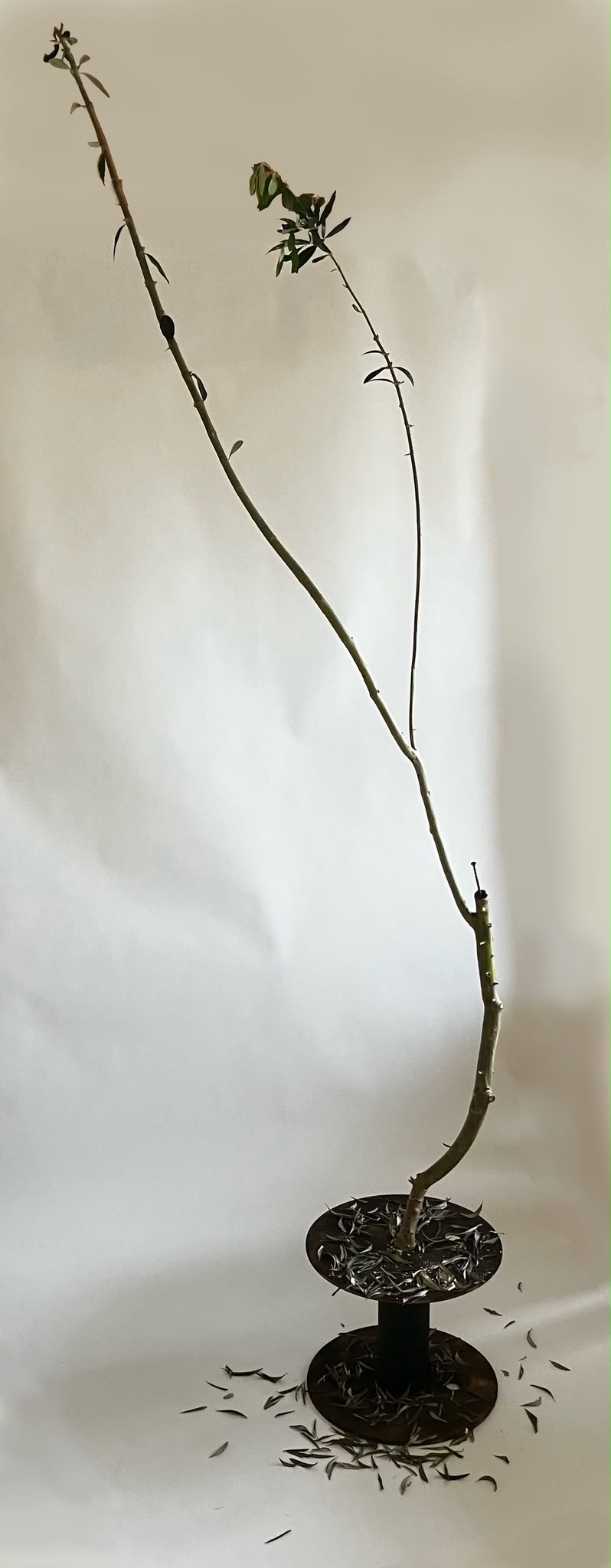
Olive branch, cable spool and screw (240cm x 90cm x 50cm)
NFS
Born in Baltimore MD, I Studied at St. Martins in London and recently took part in the inaugural cohort of the Turps mentoring programme in Margate. I utilise and push material resources; wood, glass, clay and paint with an experimental approach – trusting that some sort of visual harmony is just there, waiting to speak.
The olive tree endures and thrives across borders, countries, continents and cultures. A paradigm of resilience. The oldest olive tree in the world is thought to be the Al Badawi tree in Palestine, carbon-dated to be between 3,000 and 5,500 years old. The olive branch has a history as a symbol of peace originating in ancient Greece. It signifies hope and renewal and can be a representation of reconciliation and global goodwill.
Scorch was developed this summer from the tree in my back garden that saw no rain for 60 days.
@patrick_lears
David Nettleingham – Rewilding (2026)
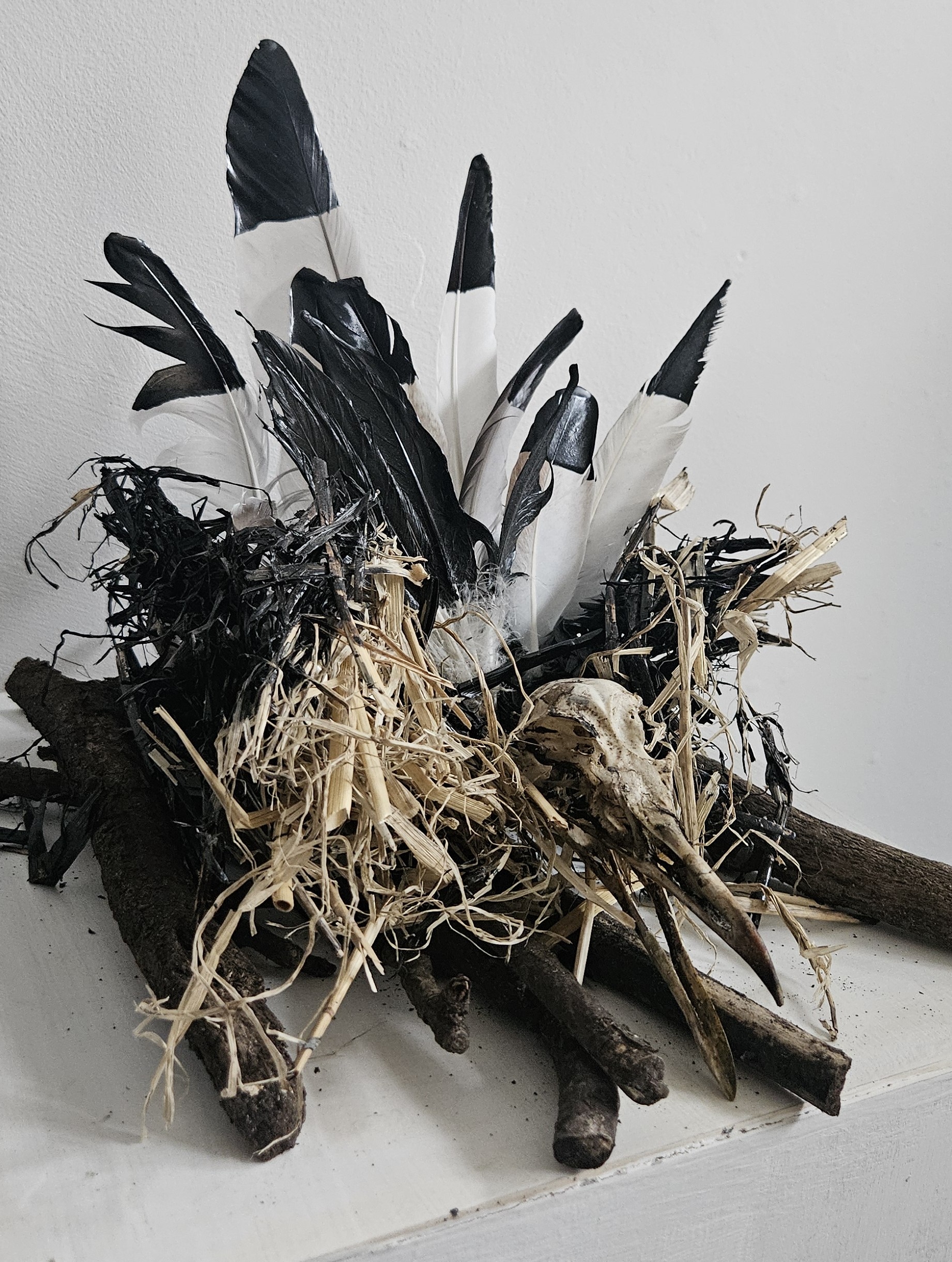
Bone, feathers, bitumen, straw and sticks
NFS
A seagull (larus argentatus), reconstructed after the slick, waterproofed, and ready to be released back into the wild. The work was slowly built from serendipitous finds, bound in a fossil fuel-based medium. It reflects very directly on the idea of being ‘too late’.
Dr David Nettleingham is a sociologist, artist and curator born and bred on the Isle of Thanet. In both his social research and creative practice, he is interested in the power of narrative, memory and folk mythologies; the material manifestations of changing social values and political imaginaries; the boundaries we draw between the ‘natural’ and ‘industrial’. He is Senior Lecturer in Sociology at the University of Kent, Co-Director of Hold Creative Spaces in Ramsgate, and founder of Thanet Experimental.
@davidnettleingham
Donna Riddington – Fata Morgana Off Ramsgate (2026)
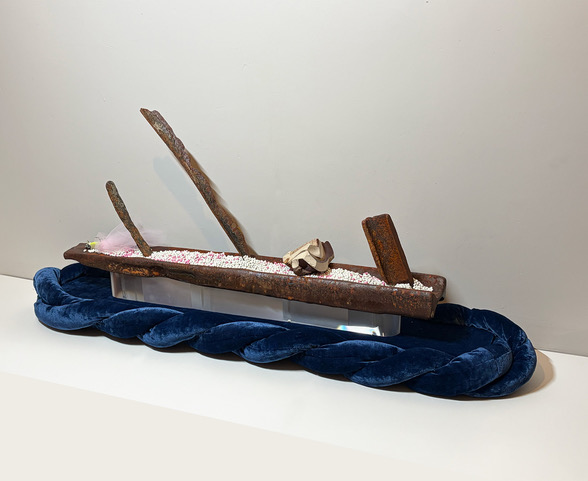
Upcycled timber and plastics (misc), painted clay, painted paper, beach foraged metal and steel, foraged lure and ceramic, velvet, tulle (53.5 cm x 119cm x 30cm)
£400
Donna Riddington is a multi-disciplinary artist, based in Ramsgate. She hails from remote inland countryside, situated near one of the world’s most polluted lakes, in Aotearoa / New Zealand. Through her art, she explores strands of cultural thinking around landscape knowledge. Themes include home, nature and conflict tensions, conservation, value and protection. For (Dis)closure, Donna presents a replica Fata Morgana*, recalled from the Ramsgate horizon. English channel shipping lanes are some of the busiest global trade routes, carrying cargo such as: consumer homewares, machinery, UK waste, oil and gas, and plastic nurdles in their billions. These freighters signify our immense capitalist drive and catastrophic environmental impacts. The Fata Morgana you see here is created from upcycled ‘skip’ timber and plastics, metal and rail track from local shorelines, foraged lure and ceramic bits, paper flatpacks, modelled clay, and stitched fabrics. This Fata Morgana acknowledges the pressure of consumer choices, capacity for change and environmental consequences.
*A Fata Morgana can be described as an optical illusion or a mirage, whereby land or vessels appear to float above the horizon as distorted shapes. These forms have been likened to fairy castles and UFOs. The name comes from Morgan le Faye, of Arthurian legend.
@donna_riddington
Ruth Rollason – Intervals (2026)
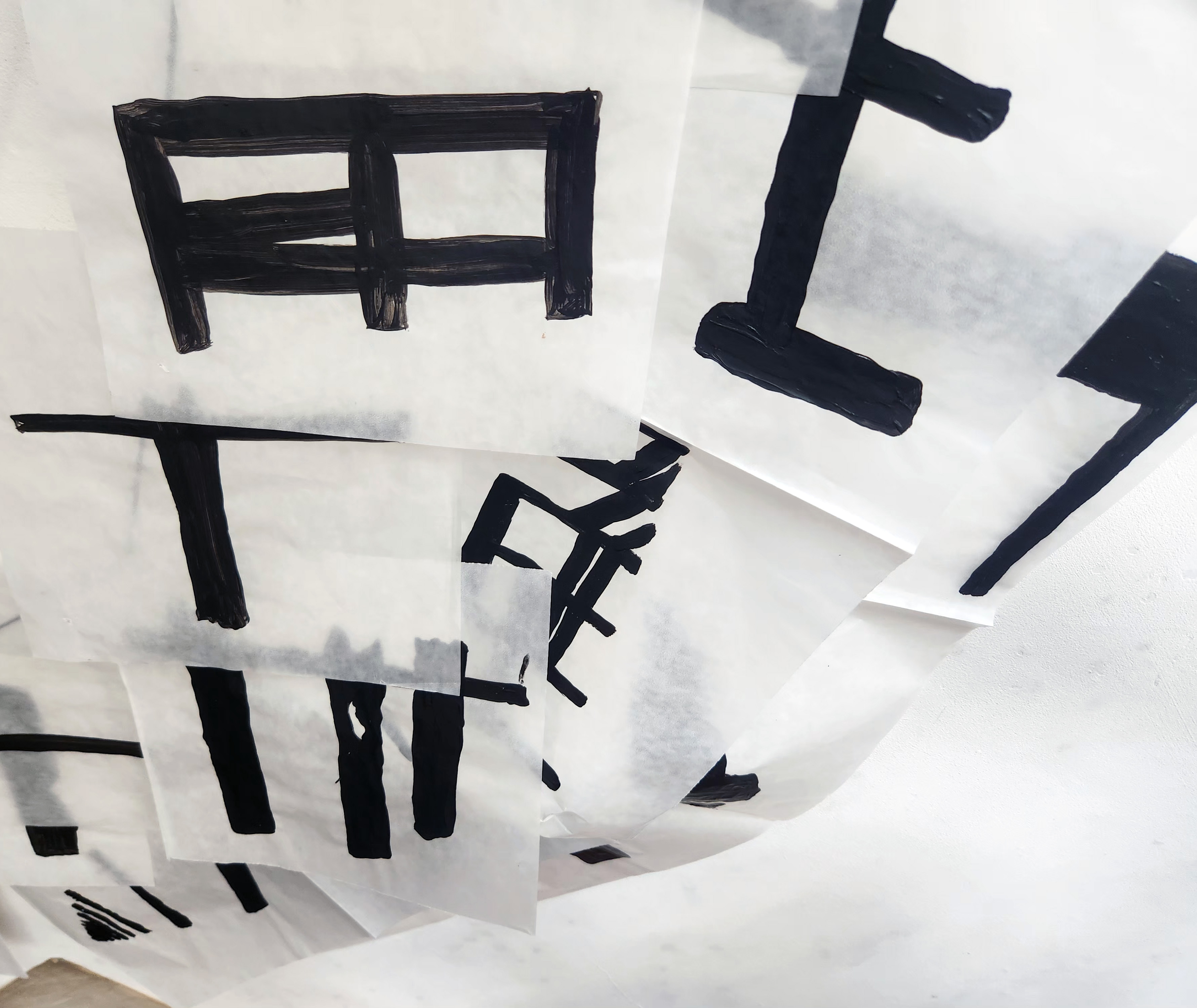
Acrylic paint, glassine, string (20cm x 20cm x 240cm approx.)
Ruth Rollason’s practice began with calligraphy and letterforms and has developed into an exploration of structure, repetition and the marks found within the landscape. Her recent work has focused on groynes, reducing these functional coastal structures to simple, abstract forms. Intervals extends this ongoing study into a new form, exploring the relationship between the visible and the obscured. The work considers the groyne not simply as a coastal structure, but as a repeated rhythm and a trace of intervention in the landscape.
@ruthcrescent
Grace Saint – Anonymous Rat (All Creatures Great & Small) (2026)
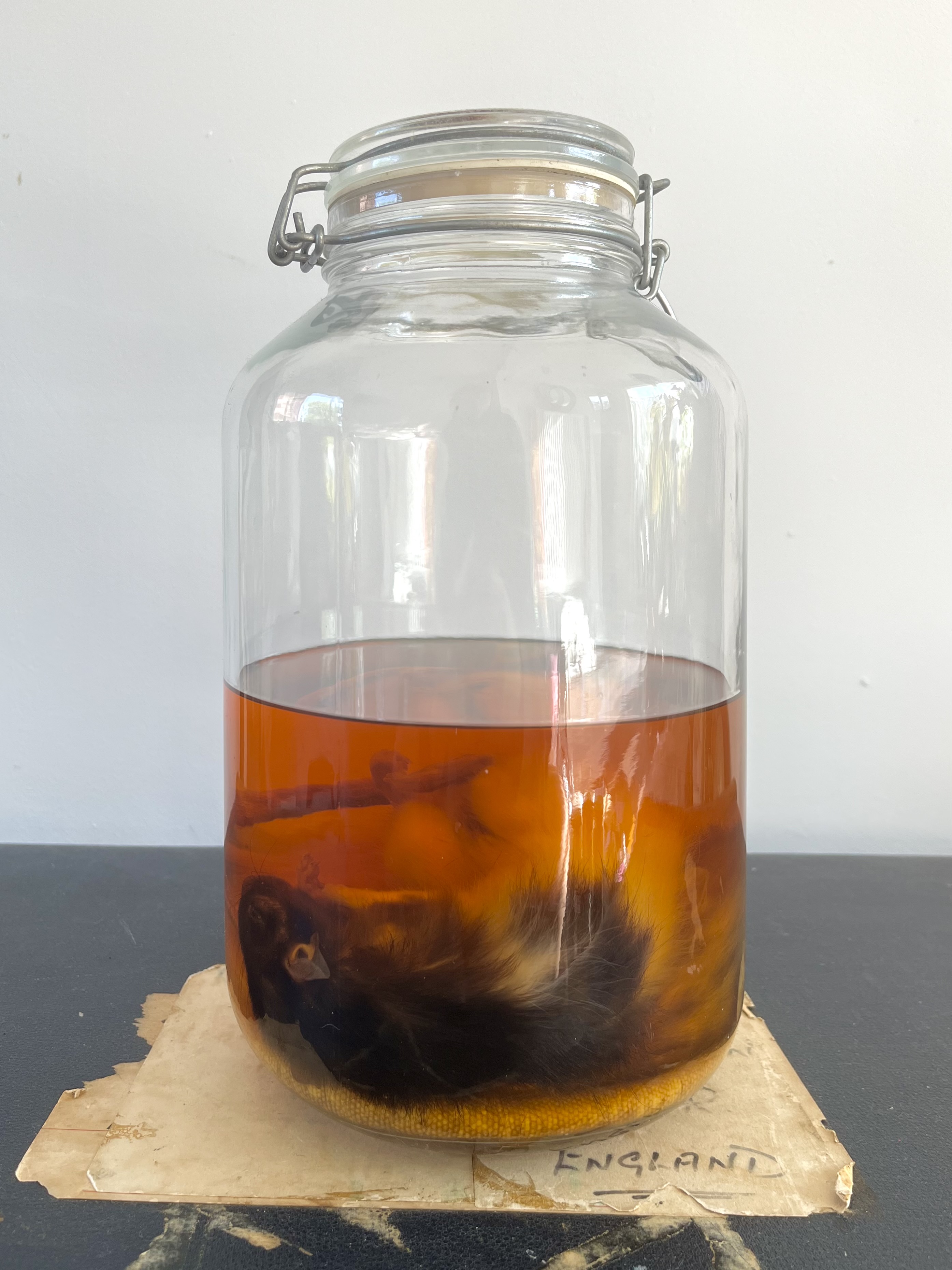
Rat, alcohol, glass (12cm x 17cm x 17cm)
£80
Saint’s relationship with the domesticated rat is a central aspect of their work. On a mostly unconscious level Saint has worked alongside and with their pet rats to reflect on the major underlying themes of the work including mistreatment, misunderstanding and the dense concept of The Mother, grief and mourning. Saint has had the pleasure of caring for fourteen rats in the past four years, three of which have also happened to be transgender. The works created with The Rats are collaborations and revelations, collaborations that are as inherent to the practice as the divine interventions at the hands of God.
@grace__saint
Eve Stickler – Reclamation (2026)
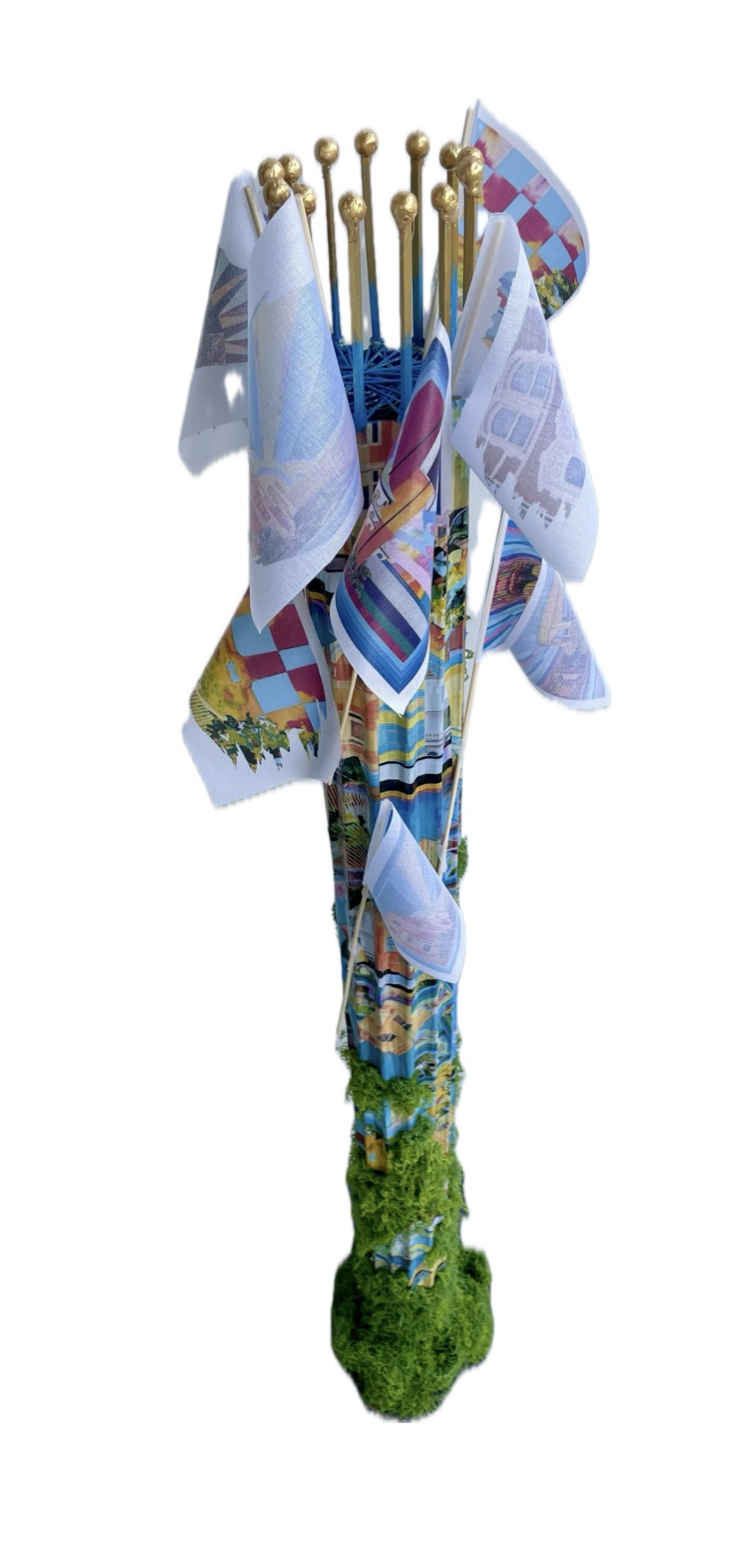
Mixed media – wood, textiles, plaster, paper, acrylic (130cm x 25cm x 25cm)
£100
Eve Stickler is a Ramsgate based artist and maker with a passion for the unique qualities of the light, architecture and colour of the town.
She develops her visual research on every local walk, noticing both the ordinary and the extraordinary, and uses those images as reference for her acrylic paintings, creating dynamic landscapes, townscapes and pictorial scenarios. She has recently developed her creative practice, manipulating motifs from her paintings to create new environments and fictional settings, always with regard and respect for the original place. Eve says her use of high colour in her work acts as a catalyst to joy. The physical act of painting takes her to a happy place, gives her focus, and increases her sense of wellbeing. Her aim is to pass on that same sense of joy to the viewer, engaging them in the fun of telling visual stories, with colour as the language that needs no translation. She has exhibited widely in London and the South East.
This piece, made especially for this exhibition is a follow up to Eve’s 2025 show The Thanetarium, a whimsical investigation of the light, architecture, vistas and joy of the Thanet towns combining paint, semi-abstraction, print and wit to create a unique glimpse of the hidden magic of Thanet from an alternative perspective.
The opportunity to take part in Disclosure has offered Eve a further chance to develop that thinking, this time sculptural and exploring themes of heritage, ownership and nature’s claw-back and questioning the impact of flag-waving in a landscape that deserves investment, preservation and celebration of all who live in it.
@edsepie
Sara Trillo – Quiver (2026)
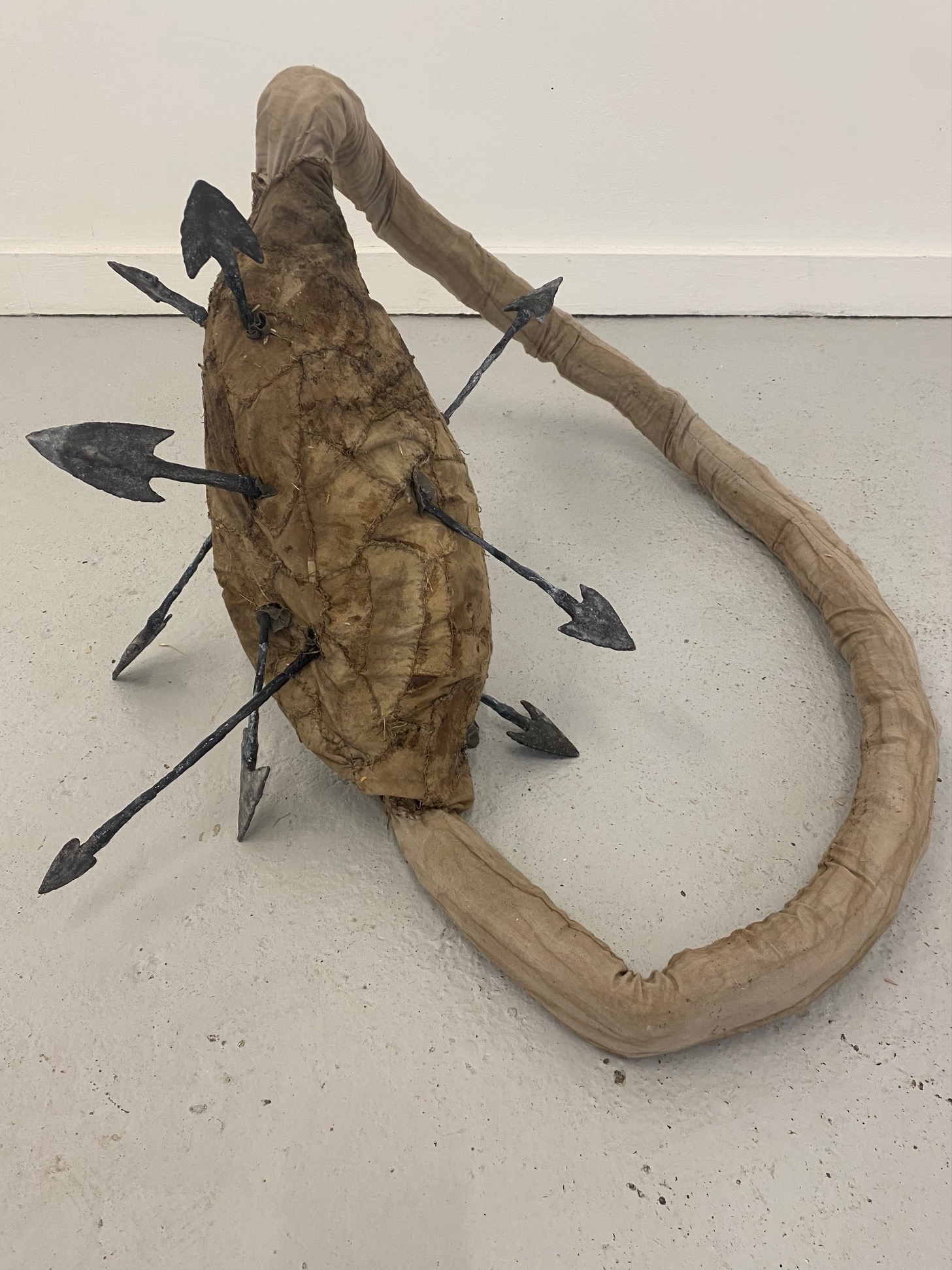
Oak gall-dyed textile, straw and clay (75cm x 72cm approx.)
POA
Sara Trillo studied Fine Art at Norwich University of the Arts, and is an Associate of Open School East. She explores landscapes through walking and making, seeking to uncover hidden histories of the human presence within our shared ecological environment. Her output is predominantly textile and clay based, and is inspired by the ancient artefacts, landmarks, and excavations she discovers when researching sites. Recent commissions include Urn Field for “How Lies the Land?” Folkestone Triennial, 2025 : Ac-Efer for “Gathering the Commons”, West Norwood Cemetery, 2025; Mouldiwarp for “Ground Up” at GroundWork Gallery, King’s Lynn, 2024; Holes in the Landscape for “Chaleur Humane”, Dunkerque Triennale Art et Industrie, 2023; and Owler for “Still and Still Moving”, Od Arts Festival, Somerset, 2023.
“Quiver” is a hand sewn, oak-gall dyed textile work stuffed with straw. It is pierced with arrows whose points are made of fired clay which have been painted with foraged clays from East Kent. The structure, colour, and patched nature of the work hints at a repurposed or abandoned artefact used by those who have illicitly gained access to an excluded site.
@saratrillo
Roosa Tulvio – Passenger (2026)
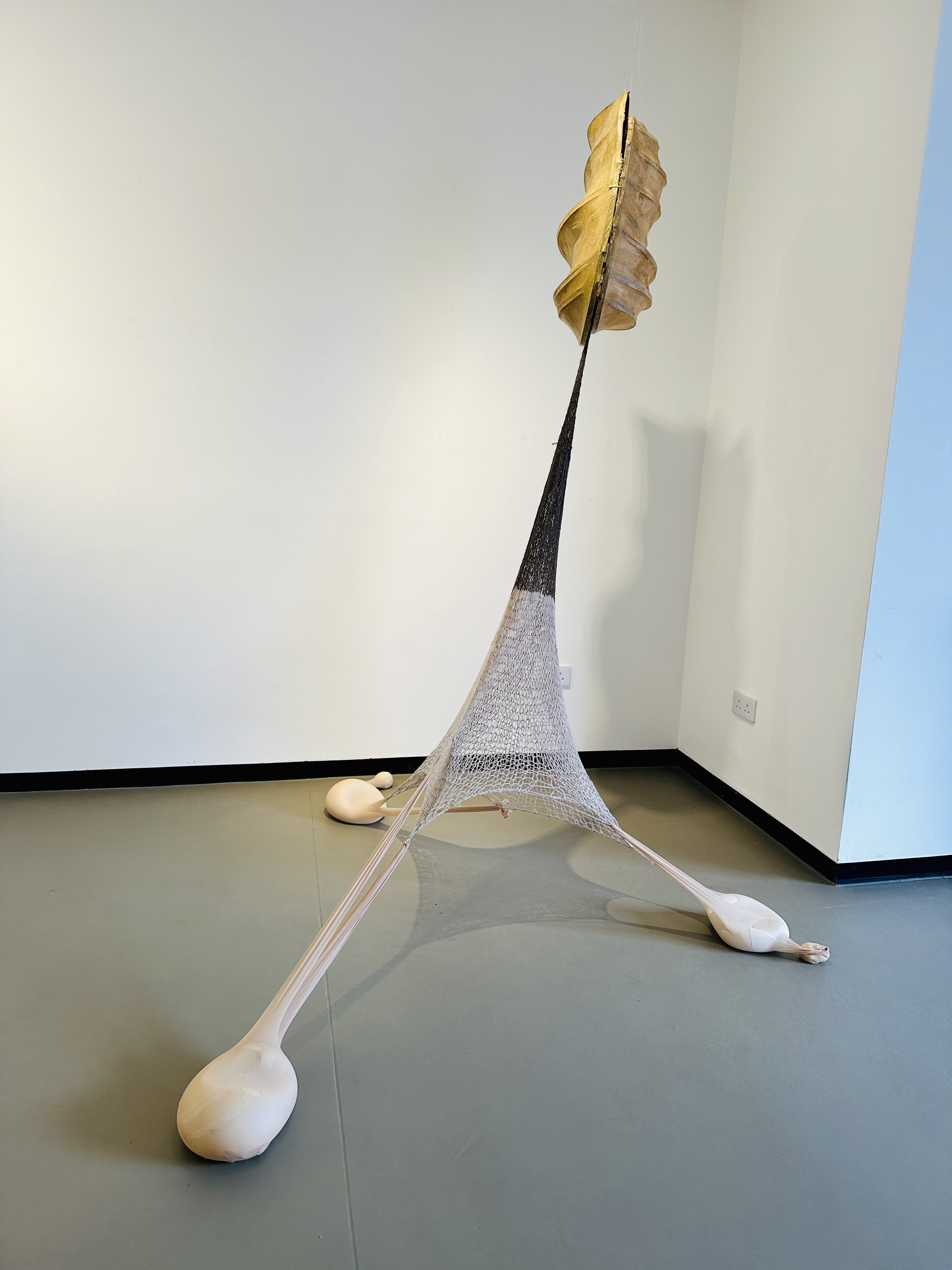
Repurposed wool yarn, cable covers, tights and recycled paper, and jesmonite (100cm x 150cm)
NFS
Roosa Tulvio is a Margate based installation artist and object maker. Her knitted sculpture Passenger (2026) is part of a larger body of work in progress, “Not all traits are adaptations” that used repurposed yarns that have been collected from garments given to her by people in her surrounding community. The work meditates on the themes of the subjective experience, the limits of human imagination, and what it means to be a particular, conscious thing. The knitted, biomorphic cocoon like shapes are new imagined life forms, dreams of the strange and often incomprehensible ways of existing of those cohabiting the planet with us. The artist tries to imagine how does it feel to glow in the dark? Occupy vertical space, grow in interconnected networks or plant roots? And can we use this embodied knowledge to exist and survive in a dying system?
@roosatulvio
 David Nettleingham